On losing the ability to read, six months of English, and the long way back.
I grew up in a house where poetry was on the walls.
Not as decoration exactly, though some of it was framed and hung. More as a working part of the household. Verses from Sufi poets whose names I knew before I knew most other things, quoted at dinner and offered as advice and produced in the middle of an argument to settle it. My parents both practised Sufism and the poetry was not separate from that. It was a tradition.
The books lived in the bookcases and were proudly displayed there, and they were not ornamental either. People took them down. My father in particular could produce the right verse for almost any situation, which is a useful skill and also, occasionally, an infuriating one when you are a teenager trying to win something.
I read fiction too, whatever I could find, though there was not a great deal published for children in Iran at the time. But the poetry was the foundation. It was the first thing I loved reading and I read it in a language I did not have to think about.
Then I left, and for a long time after that I could not read anything at all.
This is a specific kind of loss and I have not often seen it described. When you move countries as a child you expect to lose things. Friends, streets, food, the shape of your days. What I did not anticipate was losing reading.
Speaking, you can improvise. You gesture, you simplify, you point at things, you learn the fifty words that get you through a shop. It is humiliating but it functions. Reading offers no such workaround. You can either read the page or you can’t. For a long time, I couldn’t.
I couldn’t find Farsi novels in England, at least not as a fourteen-year-old with no idea where to look. And my English was six months old, which meant that everything written for people my age was beyond me and everything I could actually read had been written for children considerably younger. That was the part that stung. It wasn’t the lack of books. It was being demoted by my limitations.
After six months of learning English, I started school and in my first week I was placed in the top group for English. I want to be fair to the school here. They had a kid in front of them who was clearly not stupid, who was picking things up quickly, who gave every impression of being able to handle himself. They made a reasonable-looking decision, and it was completely wrong, but I understand how they got there.
The class was reading Shakespeare, going around the room, each person taking a passage in turn. I understood some of the words. Individual words surfaced, recognisable, floating past. What I could not do was assemble them into anything. The sentences had a shape and a rhythm that the other students were clearly following, and I sat there and could not get any of it.
And the circle was getting closer. I remember the arithmetic of it more clearly than anything else about that lesson. Counting the people between me and my turn and watching that number come down. Trying to work out which passage would land on me and whether there was any version of the next few minutes that did not end badly. The bell went before it reached me. We had run out of time.
I have thought about that a few times since, and I am still not sure whether it counts as luck. The panic did not resolve; it just stopped, mid-sentence, and got put away somewhere.
The school figured it out quickly enough and moved me to the bottom set.
Where I discovered, within about a week, that I was ahead of most of the room. Six months in the country, still assembling the language out of spare parts, and I was doing better than kids who had been speaking English since birth. They moved me again, to something in the middle, which was roughly correct and where I stayed.
Top set, bottom set, then somewhere between. They were trying to work out where I belonged and managed to get it wrong in both directions before landing somewhere roughly right.
For years after that I did not go into bookshops unless I needed something. Academic books, when a course demanded them. Books about music, because I was seventeen and had decided to become Slash and that project required research. But I did not browse. Browsing is what you do when you believe the shelves have something for you, and I had stopped believing that. Bookshops had become a place where other people went to enjoy something I had been locked out of, and it was easier not to stand there being reminded.
I would like to say this lasted a year or two, but it was longer than that.
What brought me back was a film. I watched My Left Foot sometime in my twenties, and afterwards I found out it was adapted from a book, and I read the book. That is the whole mechanism. There was nothing profound about it. I liked the film enough to want more of the story, and the rest of it was in the book.
I have wondered why a film was the thing that worked. I suspect it is because film asks nothing of you. It does not check your reading level at the door. It just runs, and you either follow it or you do not, and I could follow it completely.
And I have noticed, without wanting to make too much of it, that the book I came back through was written by a man who spent his life fighting to get words out of himself using the one part of his body that would cooperate. I am not going to claim that as a parallel. My situation was nothing like his. But I have never quite been able to file it as coincidence either.
After that I started reading fiction, but this time in English. I hadn’t really returned to the reader I had been in Iran. I had become a different one.
The poetry did return, eventually. I read in both Farsi and English now. I still read the poets, and some of them mean more to me at fifty-something than they could possibly have meant at twelve, which is presumably the point of that kind of writing.
But there were years in between when they were sitting on a shelf in a language that had gone slightly out of reach, and I am not sure I have ever fully made peace with that. You can get a language back. The years you couldn’t use it don’t come back with it.
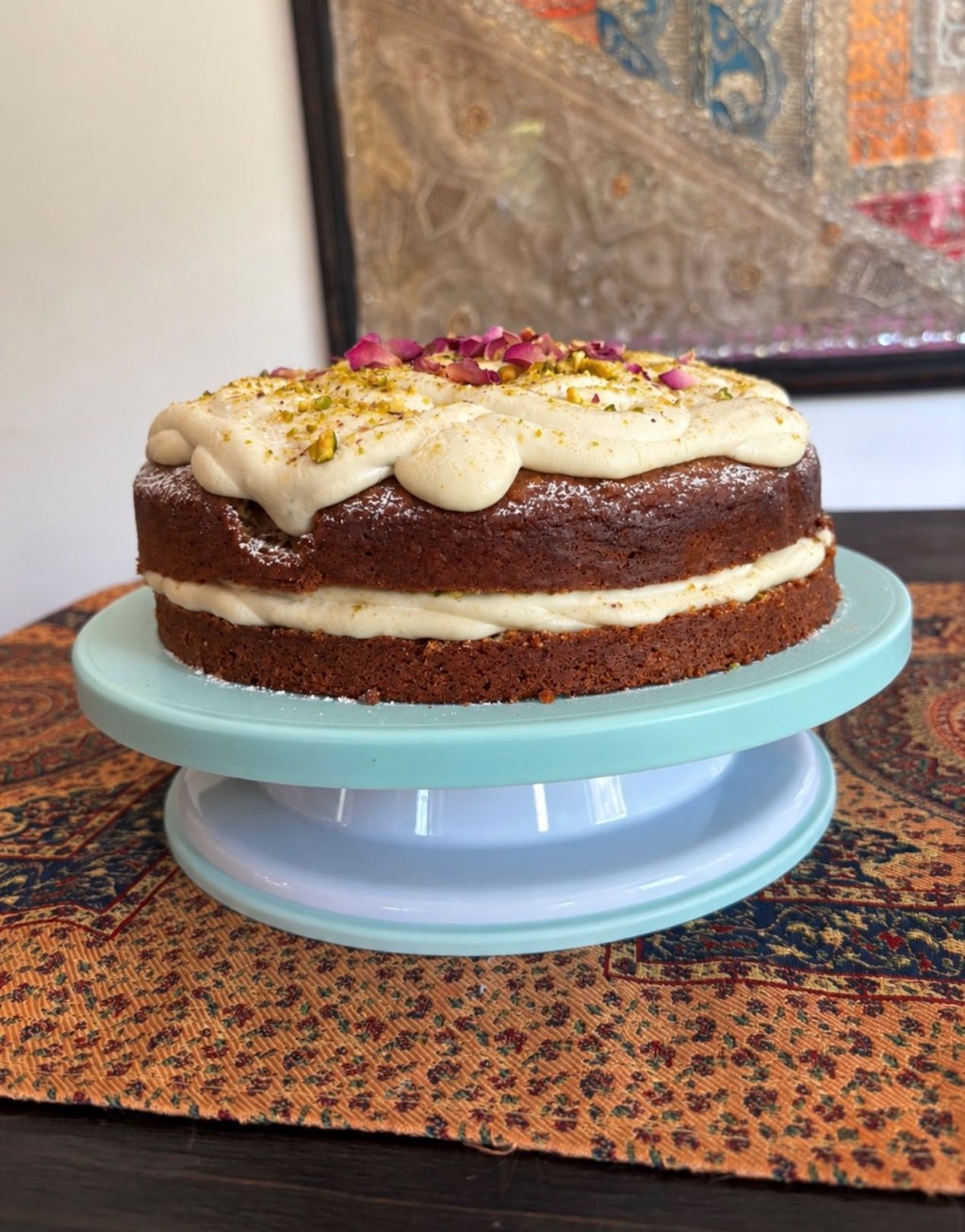
The cake for this issue is a pistachio and cardamom cake with cream cheese and mascarpone icing, and I chose it deliberately.
Pistachio and cardamom are Persian. The cake is not. It’s a Western butter cake with the flavours I grew up with inside it.
That seemed about right.
Pistachio Cardamom Cake with Mascarpone Icing
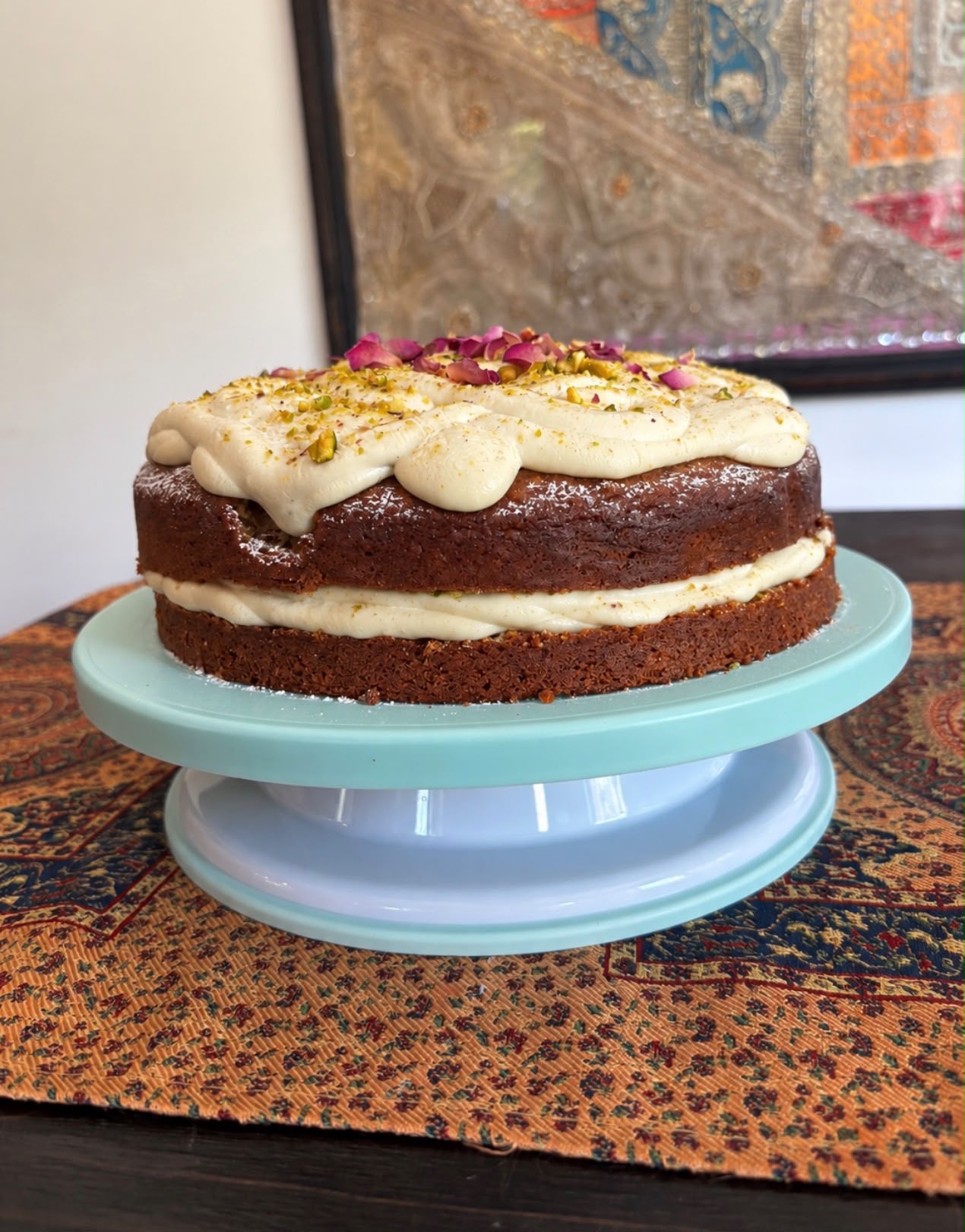
A Western butter cake with Persian flavours inside it: ground pistachio and cardamom in the crumb, cream cheese and mascarpone on top. Bring it to room temperature before serving so the cardamom opens up.
Ingredients
- For the cake:
- 180g shelled unsalted pistachios
- 200g plain flour
- 2 tsp baking powder
- 1½ tsp ground cardamom
- ½ tsp fine salt
- 225g unsalted butter, softened
- 250g caster sugar
- 4 large eggs, at room temperature
- 1 tsp vanilla extract
- 150ml whole milk, at room temperature
- Zest of 1 lemon
- 200g cream cheese, cold
- 200g mascarpone, cold
- 100g unsalted butter, softened
- 150g icing sugar, sifted
- 1 tsp vanilla extract
- ¼ tsp ground cardamom
- 30g pistachios, roughly chopped
- Dried rose petals, if you have them
For the icing:
To finish:
Directions
- Cake:
- Heat the oven to 175°C or 350°F and line two 20cm round tins. Blitz the pistachios in a food processor until they resemble coarse sand, stopping before they turn to paste, so pulse rather than run it, and check often, because the gap between meal and butter is about four seconds wide. Set aside two tablespoons for the top of the cake.
- Whisk the ground pistachios together with the flour, baking powder, cardamom, and salt.
- Beat the softened butter and sugar for four to five minutes until pale and noticeably lighter in volume. Add the eggs one at a time, beating well after each, then the vanilla and lemon zest. If it looks curdled, a spoonful of the flour mixture will bring it back. Add the dry ingredients in three additions alternating with the milk, beginning and ending with the dry, and mix only until each addition disappears.
- Divide between the tins and bake for 28 to 34 minutes until a skewer comes out clean and the tops spring back. Cool in the tins for ten minutes, then turn out onto a rack and leave until completely cold. The cake is fragile while warm and will tear if you rush it.
- Beat the softened butter with the icing sugar until smooth. Add the cream cheese and mascarpone, both straight from the fridge, along with the vanilla and cardamom, and beat on medium only until it comes together and looks glossy. This takes under a minute. Mascarpone splits if you overwork it, and once it splits there is no recovering it, so stop early and stop confidently.
- Level the layers if they have domed. Spread a generous third of the icing over the bottom layer, place the second on top, and cover the top and sides with the rest. Scatter the reserved chopped pistachios over the top, and the rose petals if you are using them.
- Refrigerate for half an hour to set, then take it out twenty minutes before serving. Cold mascarpone icing is firm and slightly dull. At room temperature it loosens and the cardamom opens up, and the cake becomes considerably better than it was ten minutes earlier.
Icing:
Assembly:

 The Tech Refugee
Leave a comment