It is 1979 and I am the youngest child in first grade, but first I need to explain why. My father’s cousin worked at the Tehran birth registry, and a small adjustment was made to my date of birth, the kind that exists in a gray area between bureaucratic creativity and outright fraud, so I arrived in school approximately a year before I was supposed to, but my parents considered this a head start. My first grade teacher appeared to consider children a personal inconvenience. She seemed like someone who had chosen teaching the way other people choose a root canal: reluctantly, and with considerable residual resentment toward the process. I don’t remember her name but I remember the way she looked at us, or wrapped us over the knuckles with a wooden ruler, all this is to say she saw us the same way a boxer looks at a punching bag, not with malice exactly, but with a kind of professional detachment toward the thing that exists to absorb impact.
Outside the classroom, though, things felt okay. Tehran was alive and vibrant, and I was six, so the world was as far as I could walk, my neighborhood small and complete, perfect in its own way. My best friend lived two doors down and was also my school desk mate, which in the logic of first grade meant she was my entire social universe. We rode on the school bus together and shared the particular misery of our teacher together, and if either of us had chocolate, we would share that too.
I loved chocolate in all its forms, cake, bar, ice cream. Not casually, but with a kind of devotion that felt serious.
Throughout first grade there were murmurs in the streets of Tehran, and gradually they got louder until large nationwide demonstrations came. Adults would huddle away from children and quietly talk about the uncertainties ahead, which of course made children pay closer attention. Schools closed, reopened, closed again. The Shah left, Khomeini arrived, and then, in the way that large historical forces always eventually make themselves felt in the smallest possible places, everything changed.
By second grade the color was gone, and I mean this almost literally. The women in my neighborhood, who had worn what they chose, now wore what they were told: dark and muted tones, covered hair, the specific visual language of a new order announcing itself through what it erases. My school was no longer co-ed, so my best friend, my desk mate, my two doors down companion, went to a different school now. It was the same neighborhood but it felt different, as if someone moved the furniture in the night and… the chocolate was gone.
Sanctions, it turns out, are not an abstraction. They are the absence of the thing you liked. They are a child standing in the shop where something used to be, understanding for the first time that the world outside his neighborhood has opinions about his neighborhood and has decided to express them by rearranging the shelves.
I want to be careful here, because I know how this sounds. A child missing chocolate while a revolution reshapes his country is not a tragedy worth recording, and people lost far more than chocolate. My own departure, a few years later, was motivated by something considerably more serious than a sweet tooth, but I think that is precisely the point. The large losses are visible and history records them, but what history doesn’t record is the life of the ordinary person being quietly altered, the desk mate who is suddenly in a different school, the colors that drain out of the street, the small pleasures that disappear without announcement because someone far away has signed something or decided something or simply stopped caring about the people on the receiving end.
This isn’t rare, and it doesn’t only happen in places that make the news. Right now, somewhere, a child is standing in front of an empty shelf where something used to be, and the reason might be a revolution or a sanction or a corporation or a government that has decided that a child’s neighborhood is an acceptable casualty of something larger. The child doesn’t have the language for any of that yet. She just knows the chocolate is gone.
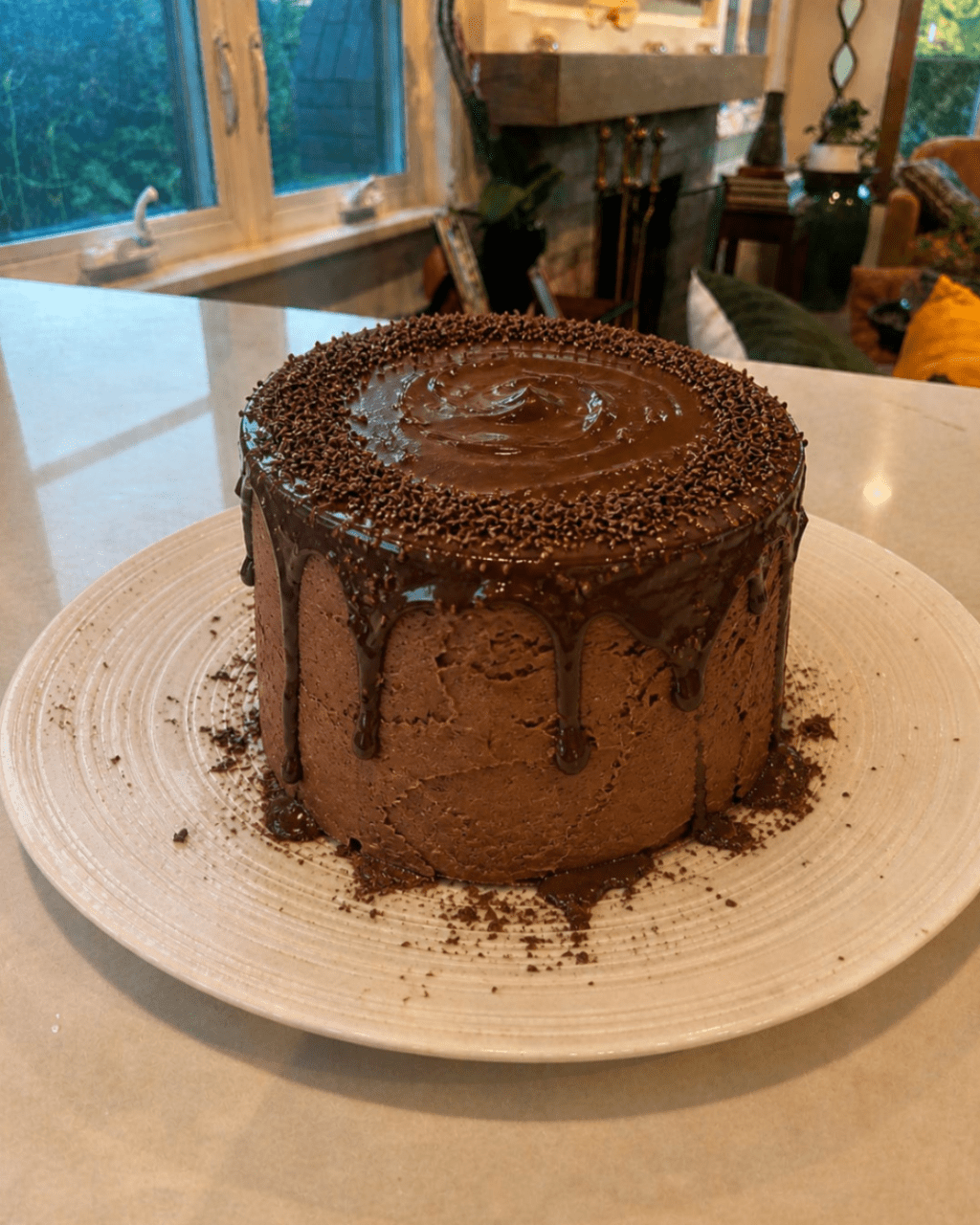
I think about this sometimes when I bake, not always, because mostly I’m thinking about whether the ganache has the right consistency and whether I chilled it long enough, but sometimes. Making something rich and putting it in front of people I love feels like my answer, in a small way. Not a solution. Just an answer. This week’s recipe is a chocolate ganache layer cake, three layers of soft chocolate sponge with a frozen chocolate crémeux in the center and a smooth ganache covering the whole thing. It takes time but it is worth it. Make it for someone.
Chocolate Ganache Layer Cake
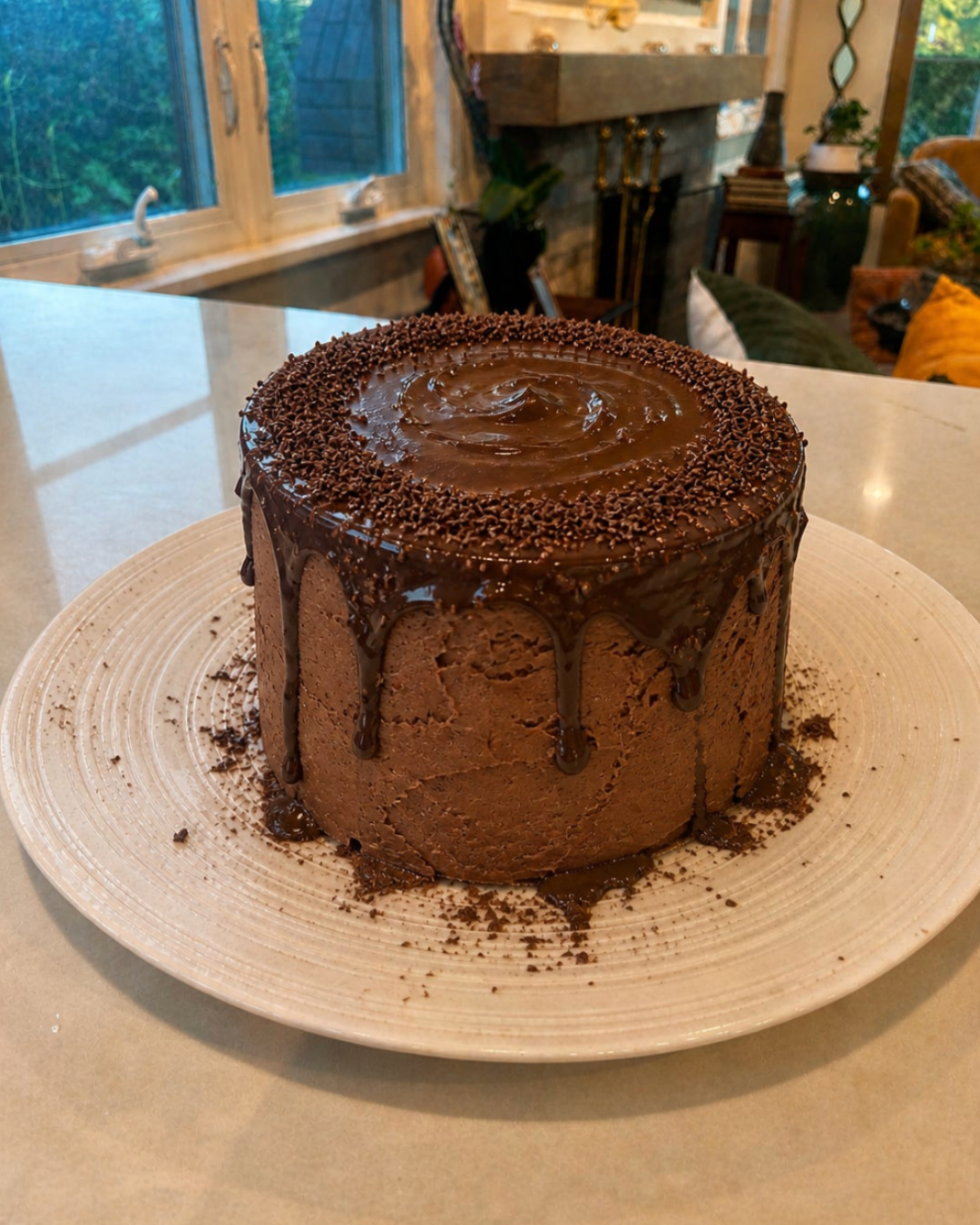
This is a project cake, and I mean that as a compliment. The ganache and the crémeux filling both need several hours of refrigeration before you can use them, so start the day before if at all possible. It rewards the planning.
Ingredients
- For the chocolate sponge:
- 200g granulated sugar
- 3 large eggs, room temperature
- 2 tsp vanilla extract
- 175g cake flour
- 75g unsweetened cocoa powder
- 1 tsp baking powder
- 1/2 tsp baking soda
- 1/4 tsp salt
- 250ml cold heavy cream
- 120g whole milk
- 60g egg yolks (about 3 large)
- 160g heavy cream
- 140g semi-sweet dark chocolate, chopped fine
- 15g granulated sugar
- 250g semi-sweet dark chocolate, chopped fine
- 225g hot heavy cream
- 225g cold heavy cream
- 50g semi-sweet dark chocolate
- 50g heavy cream
For the chocolate crémeux filling:
For the ganache frosting:
For the chocolate drip:
Directions
- Prepare the ganache frosting at least four hours ahead, or better, the night before. Chop the chocolate into a heatproof bowl. Bring the hot cream to a bare simmer, pour over the chocolate, and leave it a minute before stirring from the center outward until glossy. Add the cold cream and use an immersion blender to bring it together. Press plastic wrap onto the surface, refrigerate, and forget about it until tomorrow.
- For the crémeux filling, chop the chocolate into a bowl. Warm the milk and cream together until you see the first signs of movement at the edges. Whisk the yolks and sugar until lightened, then pour the warm liquid over in a slow stream, whisking. Return to the pan over low heat and stir until it thickens enough to leave a clear line on the back of a spoon. Pour over the chopped chocolate, stir smooth, divide between two lined 5-inch rings and freeze at least four hours until solid.
- For the sponge, heat the oven to 325F and line three 6-inch pans. Whisk the eggs and sugar on high for five to seven minutes until pale, thick and more than doubled. Whip the cold cream to firm peaks separately. Reduce speed, add the sifted dry ingredients, and mix only until just combined. Fold in the whipped cream by hand. Divide between the pans and bake 20 to 25 minutes. Flip upside down onto a rack and cool completely.
- Once everything is cold, whip the chilled ganache about a minute until it holds its shape but still moves, and pipe a ring on the first layer. Set a frozen crémeux disc in the center and cover with ganache. Add the second layer and repeat, then top with the third. Crumb coat, chill 15 minutes, then a smooth final coat. Chill another 20 minutes.
- For the drip, melt the chocolate and cream together until smooth, cool until thick but pourable, and pour over the center of the cold cake, letting it drift to the edges. Chill an hour, then bring to room temperature for ten minutes before serving so the crémeux softens.


Leave a Reply