On loss, halva, and the things a father passes down.
My father’s name was Hooshang. In ancient Persian mythology, Hooshang was a king who brought civilization and law to the world. My father had no kingdom, but for me, he left the world better than he found it.
He lost his own father when he was two years old and started working at seven, straightening nails pulled from broken furniture and wooden crates during the Second World War so they could be used again. By the time I knew him he was a man with long hair and a beard and a Sufi’s quiet certainty about the nature of existence, and he seemed to me the most permanent thing in the world.
He was not, of course, but then again, nothing is. But when you are a child you do not know that yet, and your father is your proof that the world holds together.
Everyone liked my father. Not in the polite, vague way people say that about the dead. In the specific way where strangers became friends within minutes of meeting him and people who had known him for decades still called him for advice. He had the kind of warmth that did not require an occasion. He would talk to anyone, help anyone, and occasionally help people who had not asked and were not entirely sure they wanted it, which he considered a detail rather than a deterrent.
He was generous with money, giving to friends and family and strangers who were struggling, often without being asked and sometimes without being thanked, which did not appear to bother him. He was more generous still with his time and his knowledge, sharing everything he had gathered over decades of Sufi practice with anyone who seemed interested and many others who were not quite sure they were interested until he started talking.
He could also, and I want to be clear that this is not a contradiction of any of the above, be an absolute menace.
He once took his friend’s dentures and hid them. The poor man spent most of the day looking for them, increasingly frantic, increasingly certain he had lost them for good. He found them at the dinner table that evening, sitting in front of my father, who had apparently decided this was the correct moment to produce them. If you were bending over to do something and your trousers had slipped slightly, my father would pour water down your back. He tied the legs of my nephew’s sweatpants together while he slept, waited, and said nothing.
A man who meditated daily, dispensed wisdom about forgiveness, and poured water down people’s butt cracks when the opportunity presented itself. Not a contradiction. A complete human being.
He was a devout Sufi, not in the way that gets misrepresented but in the true sense, the spiritual path of study and meditation and an internal relationship with God maintained quietly and without performance for his entire life. He understood that the trials of this world are not punishments but refining fires, that the soul must pass through heat before it becomes something nourishing.
He shared all of this freely. With family, with friends, with strangers who seemed to be carrying something heavy. People turned to him for guidance the way you turn toward warmth without thinking about it, because it is simply where the warmth is.
A few weeks before he died he asked me if I was still doing my nightly meditation.
Not asking, “How are you feeling?” Not asking, “Are you sleeping okay?” Still tending to the part of me he considered most important, right up until near the end. That was him through and through.
He used to say something to me occasionally, perhaps as a kind of apology for the times he fell short, perhaps simply as an honest statement of where he stood. He would say, “I never had a dad, so I am not sure what a dad is supposed to be like.”
I have written before about my own version of that uncertainty, the doubt that sits between the parent you intend to be and the one you actually manage. I did not know when I wrote it how clearly I was writing about something inherited. He did not know what a father was supposed to be like and he figured it out anyway, imperfectly and with enormous generosity. This is what he passed down. Willingness to try without certainty.
Once, I was telling him about someone who had betrayed him, working myself up on his behalf, expecting him to agree that this person deserved whatever judgment I was building toward. He stopped me. He said: there is no point in digging up the past. Don’t hold grudges. The past has passed.
That was the end of the conversation, and the end of my grievance on his behalf, and I have thought about those three sentences many times since. A man who had more reason than most to hold grudges against life, who had lost his father at two and straightened nails at seven and had moved countries because of a revolution, choosing not to dig any of it up. That is not passivity. That is a decision made repeatedly, over a lifetime, in the direction of release.
The Sufis have a word for this. Most traditions do, in one form or another. My father just lived it, which is harder.
I am writing this from London, where I came not because I planned to but because life decided, and life in this case arrived wearing the face of death. My father had been ill. I came to see him before he went, and I was just in time, which is the thing I am most grateful for.
When I walked into the room he was heavily medicated to help him with the pain. But after a while he opened his eyes and saw me. He said a few sentences. He asked about my children. That was the last real conversation we had, and it was exactly like him that the last thing he wanted to know about was the next generation.
The next evening he was gone, peacefully, surrounded by the people who loved him, and ready in a way I did not know was possible until I saw it. Each family member said their goodbyes in their own way. When it was my turn I put my head against his and told him I loved him and would miss him, and then I told him to go. To leave this place and continue his journey, because that is what he believed, that life does not end but simply moves on to the next stage, the soul becoming one with existence in the way that Sufi tradition describes and that I cannot fully explain but felt, in that room, to be true.
The body was not him. I want to say that clearly because it surprised me. The next day, and again when we took him to be washed in the Islamic tradition, what was there looked nothing like my father. He had already gone. I had understood the Sufi teaching about the soul and the body as a concept. Standing in that room, I understood it as a fact, and I found it, unexpectedly, to be a comfort.
When I watched him leave, surrounded by people who loved him, going without pain and on his own terms, I felt something I can only describe as envy. Not the dark kind. More like seeing someone do something with grace and wishing you might manage the same. He had done this right. After everything the world had put him through and everything he had given back, he left in peace. I hope when my time comes I manage it half as well.
Grief keeps changing shape. Sometimes it is the straightforward missing of a person, the knowledge that he is not there to call, that the next time I go to England he will not be in his chair. Sometimes it is a dizzying feeling of losing a person who made you feel safe in the world. Sometimes, and this is the one I least expected, it is a gratitude so large it has nowhere to go.
I did not see him enough after I moved to America. I will carry that regret quietly. I am also choosing not to let it be the thing that defines how I remember him. I was there at the end. He opened his eyes and saw me. He asked about my children.
That is enough. I am choosing to let it be enough.
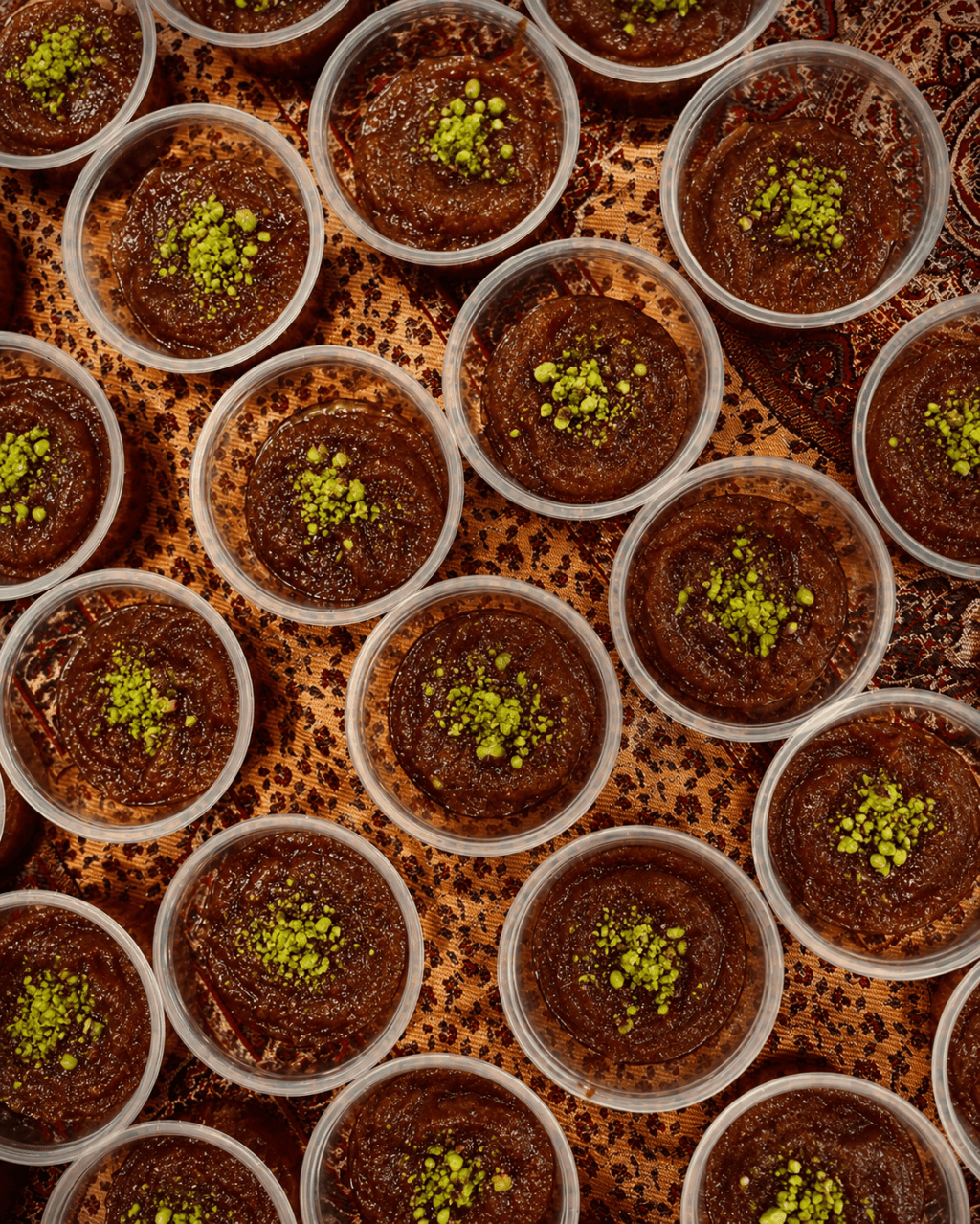
My wife made halva in California while my sisters took care of the same in England. The same act of love, the same prayer, on two continents for one man.
In Persian tradition, halva is made when someone dies and given to family and friends as an act of remembrance. In the Sufi understanding my father carried, the meaning goes deeper. Bitterness is met with sweetness because God’s mercy outlasts grief. The flour is roasted slowly until it darkens because the soul must pass through trials before it is refined. Feeding others extends the generosity of the person who has died because character does not end with death.
There is one more thing about making halva. Everyone who helps must say a prayer for the person who has passed. Every stir of the pot is an act of remembrance. The making of it is not cooking. It is a collective prayer in the form of a recipe.
He would have understood that completely. He understood, better than anyone I have known, that the intention behind an act is the act itself.
Persian Halva
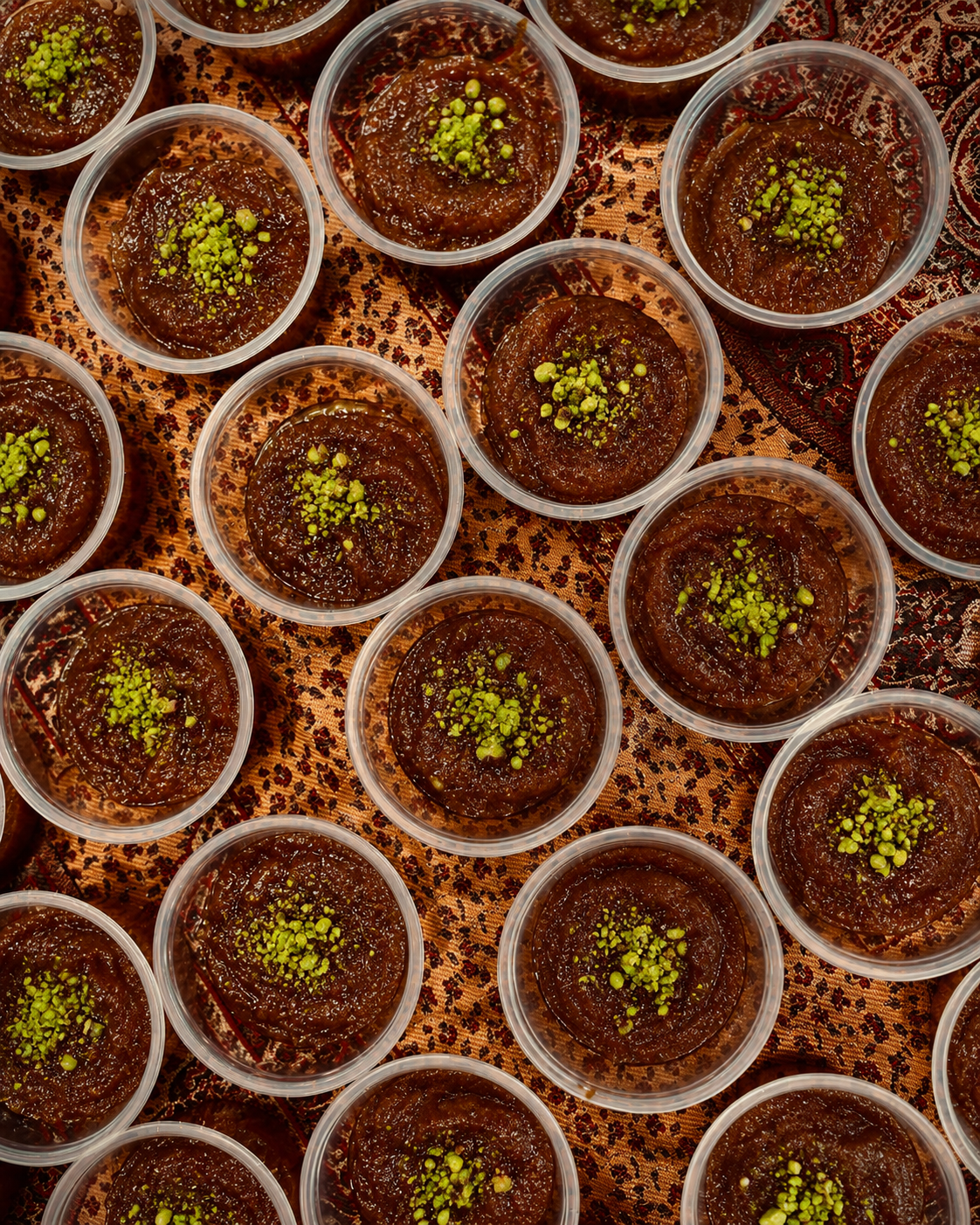
This is not a recipe you make alone. Anyone who helps must say a prayer for the person being remembered as they stir. The intention is the ingredient that cannot be measured and cannot be left out. Toast the flour patiently and do not rush the darkening. That is where the flavor and the meaning both live.
Ingredients
- 250g plain flour
- 200g unsalted butter
- 150g caster sugar
- 250ml water
- A generous pinch of saffron, bloomed in 2 tbsp hot water
- 1 tsp ground cardamom
- 1 tsp rosewater
- Slivered pistachios or almonds, to decorate
Directions
- Bring the water and sugar to a gentle simmer, stirring until the sugar dissolves. Add the bloomed saffron, cardamom, and rosewater and keep it warm over the lowest possible heat.
- In a wide heavy pan, melt the butter over medium-low heat. Add the flour and begin to stir. This is the part that cannot be rushed and cannot be left unattended. You are toasting the flour in the butter, slowly and continuously, until it turns a deep golden brown and smells nutty and fragrant. This will take between twenty and thirty minutes. The color you are looking for is somewhere between dark caramel and walnut, deep enough that you are slightly worried and then slightly more. That is where the flavor is.
- When the flour has reached that color, reduce the heat to its lowest setting and begin adding the warm syrup a ladleful at a time, stirring continuously. It will spit and bubble at first. Keep stirring. The mixture will come together into something thick and glossy and deeply fragrant. When all the syrup is incorporated, continue stirring for another few minutes until the halva pulls away from the sides of the pan.
- Transfer to a serving dish, press gently into shape, and decorate with slivered pistachios or almonds. Serve warm or at room temperature to the people who have come to remember.
As you stir, say a prayer. Say it in whatever language feels most like home. Say it for the person who made you who you are, imperfectly and without a map, and did it anyway.
P.S. If you have lost someone and want to tell me about them, not the grief but the person, reply and tell me. I read every one, and right now I especially mean it.


Leave a Reply