On the family shop, the people who came through it, and the five years I spent trying to get out.
About a year after we arrived in England, my father decided he needed to start a business.
In theory, he had options. In Iran, he had been VP of purchasing for a large company and had run a business of his own alongside it. None of that transferred. A career does not come through customs with you. What came through was a man in his late forties with a family to look after and a CV that, as far as anyone in England was concerned, began when he landed.
So he bought a run-down supermarket and named it after my eldest sister. Leyla Foods.
We fixed the place ourselves, all of us, because that was the only labour available. We opened it as a supermarket focused on Iranian food, which, at that point in that part of England, wasn’t a crowded market. I was just about to start my A-levels, which in Britain means two years of study on three or four subjects, and which determines where and whether you go to university. The shop was open until two in the morning.
Those two facts did not fit together, and nobody pretended otherwise. They just both had to be true at the same time.
The work itself was dull in a way that is hard to convey. Stacking shelves, then restacking them. Working out what to buy and what to charge for it. Pricing things by hand. Every so often one of us would do the four in the morning run to the fruit and vegetable market, which meant that sleeping in the room at the back of the shop was sometimes more sensible than going home.
I did five years of this, through A-levels and an early part of university.
And honestly, the shelves were the easy part. The customers were the job.
There were rude ones, which you expect. There were the racist ones, which in England in the late eighties you also expect, though expecting a thing does not do much for you when it is standing at your till. The drunks came after eleven and were more manageable than people assume. They wanted junk food, and they wanted to tell you something.
The worst were the hagglers.
These were not people in difficulty. These were people who would stand at the counter and argue with a teenager over the price of a bag of rice or a bunch of parsley, grinding away for three or four percent. Not to save money in any way that would register in their lives. For the pleasure of it. It was a sport, and I was the pitch.
What I did not fully appreciate at the time is that some of them, having failed with me, would try my father.
This was a man who had negotiated purchasing for a large company as his actual profession. Haggling was not a thing that happened to him. He did it daily, at volume, with people whose job was also to do it. He gave genuine discounts to regulars and better ones to anyone buying in large quantity. Beyond that, he was not interested, yet very pleasant about it.
My father’s English in those years was a few steps behind his sense of humor, and the gap between the two made him genuinely hazardous.
A customer once came in and asked for condoms. My father misheard and offered him candles.
There was a young man who lived in the flats above the shop and came to the shop fairly regularly. He would wear heavy mascara, had jet-black dyed hair, and wore black all the time. One evening in early November he came to the shop, my father looked at him and, in a tone of mild helpfulness, said that Halloween was finished.
He was not being cruel. He would have been baffled by the suggestion. He had noticed something, and he said it, which was his approach to the English language and life.
And then there were the pets. The poodle that bit me for simply handing her owner a carton of milk, the dogs that would want to pee next to the produce outside the store, and then there was the time a dog set the whole shop into chaos. A man and his dog were standing by the door of the store and apparently another customer already in the store had a fear of dogs. The scared customer was running around the shop and screaming while the other one was trying to show the dog was friendly; this created a bizarre and comedic scene that set off my sister into a fit of laughter, to the point that she had to hide behind the counter. The dog, the screaming customer and I carried on without her.
One regular customer that did not haggle was the homeless man that slept by the church across the road from the shop. He would come in to buy food and most of the time we would not charge him, but he wanted to pay for his items; perhaps that gave him a sense of normality. He would pay and then put some of his change in the charity box next to the register. He did it every time.
After a while, the shop began to take its toll on all of us. My siblings and I were fed up with working the long hours after a day of school/work. There was almost no social life as the shop was the priority. My dad was also getting tired.
When I look back at the period we owned the shop, I feel a sense of sadness. There was a lot of time and energy wasted that I never got back. It also left a bitter taste in my mouth and changed the way I feel about people. One of the saddest things that happened was when my dad was mugged on the way home.
Normally there’ll be a couple of us at the shop, but that night he was walking home by himself. The house was only a 10-minute walk, but along the way two men grabbed him, put a knife to his throat, and took all his money.
I’ll never forget the look of stress and anxiety on his face as he walked through the door. He was shaking and could barely walk, he had to lean against the wall to walk into the house. There was a scratch on his neck where the thief placed the knife.
I HATED THE SHOP!
A couple of years into owning the shop, he was diagnosed with type two diabetes. After that, he started to complain of chest pains. He had an angiogram which showed he required a quadruple bypass and a long recovery with complications from an MRSA infection that he got from the hospital.
After six years, we sold the shop. I was glad. I did not miss it one bit. I got my hours back.
My dad never talked about it, but I knew he was also happy to sell the shop. It took a lot out of him. He went from a VP-level employee with a profitable side business to an ordinary shopkeeper. That had to feel like a gut punch, and he got on with it.
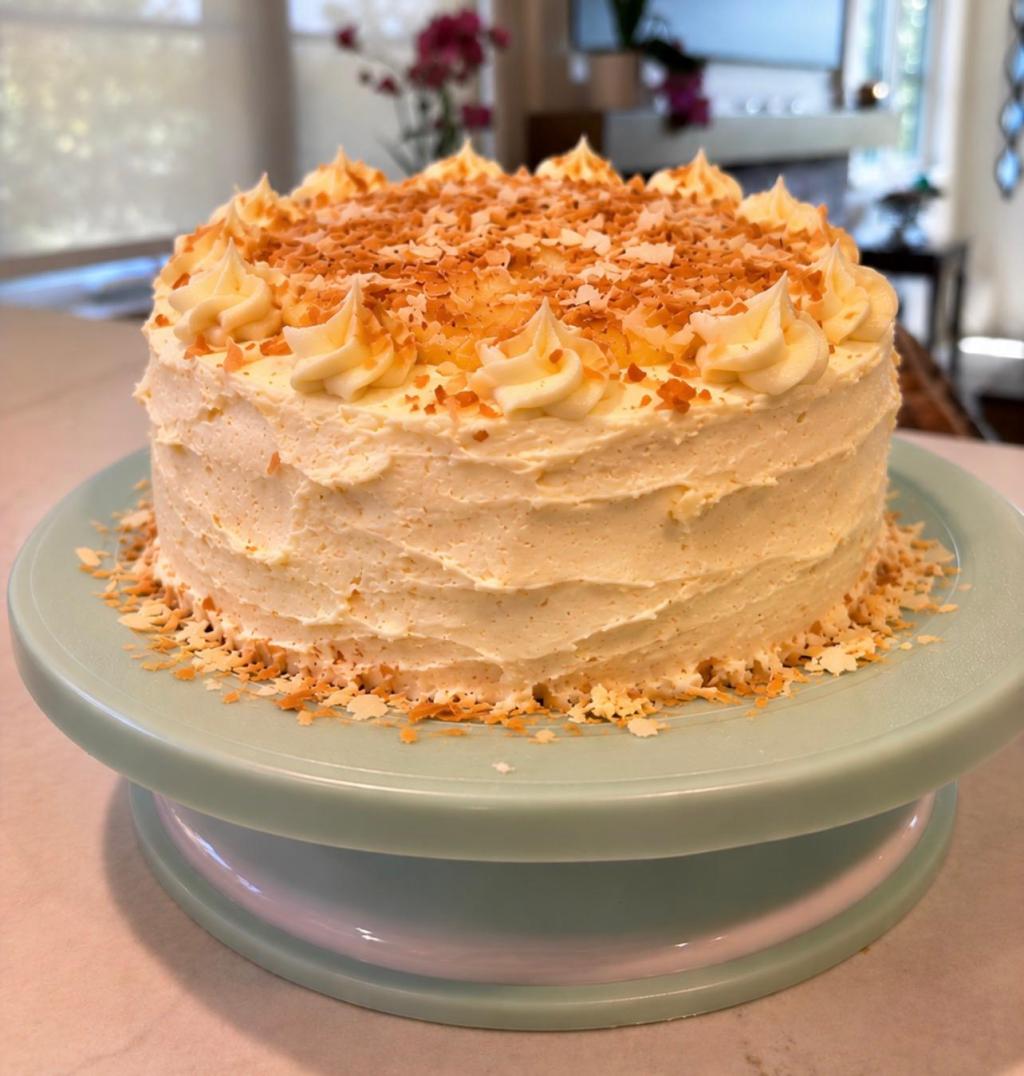
The recipe for this issue is a coconut cake, and the reason is the Crème pâtissière.
When we arrived in England, the sweets were wrong. Not bad, wrong. The cream inside a cream puff was barely sweetened, which to a boy raised on Iranian pastries was close to an insult, and everything in the bakery window tasted roughly as unfamiliar as the streets outside the bakery. I was thirteen and finding the whole country mildly incorrect, and the pastries were part of it.
Except for the Crème pâtissière. That tasted the same as it did in the Napoleon cake I used to eat in Tehran. Same custard, same thickness. One thing had come through the move without being altered.
So this cake is a coconut cake with coconut pastry cream between the layers. It takes most of the day, and it is worth it.
The pastry cream recipe I used was from this cake by Kitchen-By-The-Sea and the cake and the buttercream are from Sally’s Baking
Coconut Cake with Coconut Pastry Cream
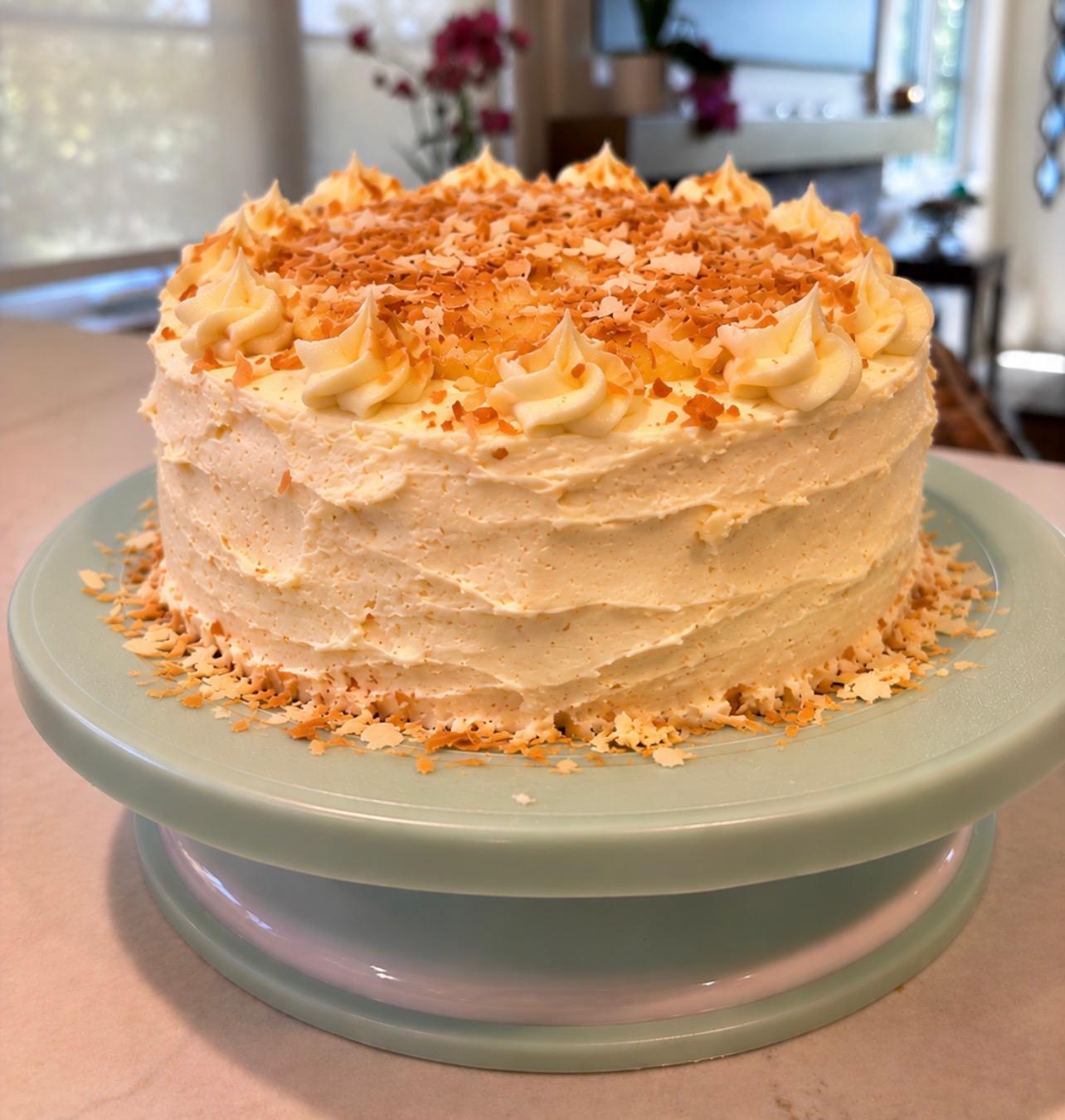
Three layers of coconut cake filled with coconut pastry cream and covered in cream cheese coconut buttercream. Make the pastry cream first so it has time to chill.
Ingredients
- For the pastry cream:
- 1 cup toasted coconut flakes
- 2 cups whole milk
- 1 tablespoon vanilla bean paste
- ¼ teaspoon salt
- 1/2 cup minus 1 tablespoon (90g) sugar
- ¼ cup flour
- 4 egg yolks + 1 whole egg
- 2 and 1/2 cups (285g) cake flour
- 2 teaspoons baking powder
- 1/2 teaspoon baking soda
- 1 teaspoon salt
- 3/4 cup (12 Tbsp; 170g) unsalted butter
- 1 and 2/3 cups (330g) granulated sugar
- 5 large egg whites, at room temperature
- 1/2 cup (120g) sour cream, at room temperature
- 2 teaspoons pure vanilla extract
- 1 teaspoon coconut extract
- 1 cup (226g/240ml) unsweetened canned coconut milk
- 1 cup (80g) sweetened shredded coconut
- 100g unsalted butter, softened
- 100g full-fat cream cheese, softened
- 200g icing sugar, sifted
- 20ml tinned coconut milk
- ½ tsp vanilla extract
- ½ tsp coconut extract
- Pinch of salt
- Toasted coconut shavings
For the cake:
For the cream cheese buttercream:
To finish:
Directions
- Pastry cream:
- Toast the coconut flakes over medium heat until just golden, then set aside to cool. Set a fine-mesh sieve over a clean bowl, ready for the finished cream.
- In a second bowl, whisk the egg yolks, whole egg, flour and sugar until smooth.
- Put the milk, vanilla bean paste and salt in a saucepan over medium-high heat and bring to just under a boil, stirring now and then so the milk does not catch on the bottom of the pan.
- Whisk a third of the hot milk into the egg mixture, whisking constantly so the eggs do not cook, then pour it all back into the pan. Whisk over medium heat until it is as thick as lightly whipped cream and only just comes to a boil. Any further and it will curdle. Strain it into the bowl straight away, because it keeps cooking if it stays in the pan.
- Cool for 10 minutes, stirring occasionally, then stir in the toasted coconut. Press plastic wrap directly onto the surface so it does not form a skin, and chill for about 1 hour while you make everything else.
- Heat the oven to 350°F (177°C). Grease three 8-inch cake pans, line the bases with parchment paper, then grease the parchment.
- Whisk the cake flour, baking powder, baking soda and salt together.
- Beat the butter and sugar on medium-high speed until smooth and creamy, scraping down the bowl as needed. Beat in the egg whites, then the sour cream, vanilla and coconut extract. It will look curdled at this point, which is normal. With the mixer on low, add the dry ingredients and the coconut milk, then the shredded coconut. Finish by hand to catch any lumps of butter at the bottom of the bowl. The batter will be slightly thick.
- Divide the batter evenly between the pans and bake for 21 to 24 minutes, until baked through. Cool in the pans on a rack for 1 hour, then turn the cakes out onto the rack to finish cooling.
- Beat the butter and cream cheese on medium speed for about 2 minutes, until smooth. With the mixer on low, add the icing sugar, coconut milk, vanilla, coconut extract and salt, then beat on high for 3 minutes. Add more icing sugar if it is too thin, more coconut milk if it is too thick, or a pinch of salt if it is too sweet.
- Stack the cake layers with the pastry cream in between, cover the cake with the buttercream, and sprinkle toasted coconut shavings on top.
Cake:
Buttercream:
Assembly:


Leave a Reply