On reinvention, a Gibson Les Paul, and the specific gap between who you think you look like and who you actually look like.
When you arrive in a new country at thirteen, one of the first things you have to figure out is who you are going to be. The person you were before does not quite translate. The language is different, the references are different, the rules about what is cool and what is not are different, and you are standing in the middle of all of it trying to work out which version of yourself has any chance of surviving the next few years.
I gave this considerable thought. I looked at my options. And somewhere around the age of seventeen, living in England in the late 1980s, I made my decision.
I was going to be Slash.
For anyone unfamiliar, Slash is the lead guitarist of Guns N’ Roses. He is tall, lean, and permanently dressed in a top hat and leather jacket. He has a cigarette in one hand and a Les Paul in the other and he moves through the world with the specific loose-limbed confidence of someone who has never once worried about what he looks like because he has always looked exactly like that. For all I know he was born with long curly hair and a tophat.
I was none of those things. I was seventeen, bulky where Slash was lean, Iranian where Slash was Anglo-American, and in possession of a puberty face that was, to put it charitably, still finding itself. But I had been to my first concert at sixteen, the Eurythmics, then Prince and since then had seen Guns N’ Roses, Metallica, Megadeth, and many more, and something about all of that live music, the volume and the energy and the sheer physical fact of it, had settled something in me that I had not known was unsettled.
I wanted to play guitar. I wanted long hair. I wanted, if I am honest, to look like someone who played guitar and had long hair. These are not always the same ambition, but at seventeen they feel like they should be.
So I grew the hair. I started learning guitar. I bought the magazines, Kerrang and Guitar World and whatever else was on the shelves, and I read them cover to cover, tracking album release dates, following tours, learning which guitarist played what and why it mattered. There was no internet. Everything you knew about music you had to go out and find, and I found as much of it as I could afford, which meant cassette tapes first, then LPs, then CDs as the decade turned. I would bring them home, put them on, and sit on the floor reading the lyrics from the sleeve while the music played. This felt important. It was important.
There was a stretch of guitar shops along Tottenham Court Road in London that I visited with the regularity and reverence of someone attending a place of worship. I could not afford anything in them. This did not stop me going. I would stand in front of the guitars and look at them the way you look at something you have decided you are going to have eventually, not with longing exactly, but with a kind of patient certainty. I knew which one I wanted. It was a Gibson Les Paul, the same guitar Slash played, sunburst finish, the weight and curves of it exactly right in a way I could not have explained but felt completely certain about.
I saved up. It took a while. And then one day I walked into one of those shops on Tottenham Court Road and I walked out with a Gibson Les Paul and I have never sold it and I am never going to.
That guitar is in my house right now, almost forty years later. The hair is gone. The silver rings are gone. The top hat was never really part of the plan, if I am being honest. But the guitar stayed, which tells you something about which part of that teenage reinvention was a phase and which part was actually me.
I should address the hair more directly.
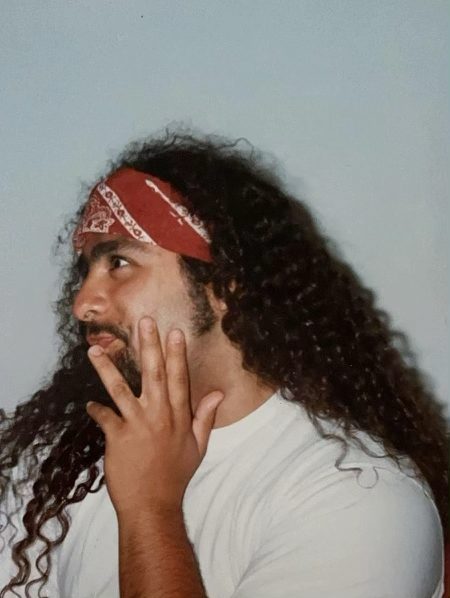
It was long. It was very long. I grew it through college and into my early twenties and I was, during this entire period, convinced that it looked good. I was wrong. I know this now because my son found the photographs.
He is nine years old and he looked at a picture of me from this era and said, without hesitation or diplomatic softening of any kind, that I looked ugly. My wife, when consulted, did not disagree. My daughter, who is sixteen and has strong aesthetic opinions, reviewed the photographic evidence and also did not disagree. I am outnumbered three to one by my own family on this question and I have reluctantly made my peace with it.
What I will say in my own defense is that the look made a certain kind of sense in context. Long hair, silver jewelry, the general energy of someone who had absorbed a significant amount of rock/heavy metal and was not keeping it entirely to himself. In late 1980s and early 1990s England this was not exactly a recognizable type. The problem, as I understand it now, was less the individual elements and more the overall impression it created, which was less Slash and more, as I once heard it described by someone whose opinion I did not ask for, a stereotype of a background character in a film about South American organized crime.
I did not see it at the time. I refuse to see it now. Truth hurts.
The hair had to go at twenty-one. Not because I wanted to cut it but because I had finished college and needed a job, and the corporate consulting world of the early 1990s had strong and non-negotiable opinions about hair length on men. I sat in the chair. The hair came off. I looked in the mirror at someone who looked considerably more employable and considerably less like anyone from a band, and I went and got the job.
This is how it usually ends, the teenage reinvention. Not with a dramatic moment of self-realization but with a practical concession to the world you are trying to enter. You put the leather jacket away. You cut the hair. You keep the guitar, because some things you are allowed to keep, and you go and become a technical program manager, which is about as far from Slash as it is possible to get while remaining in the same species.
I do not regret any of it. The music is still with me. The guitar is still with me. And the version of me that stood in those guitar shops on Tottenham Court Road, pressing his nose against the glass at instruments he could not yet afford, saving up with the quiet certainty that one day he would walk out with the right one, that version of me was doing something important that had nothing to do with looking like Slash.
He was figuring out what he loved. In a country that was not yet fully his, in a language he was still making his own, through music that was loud enough to drown out everything he was uncertain about. That is not a phase. That is how a person finds themselves, one cassette tape and one guitar shop at a time.
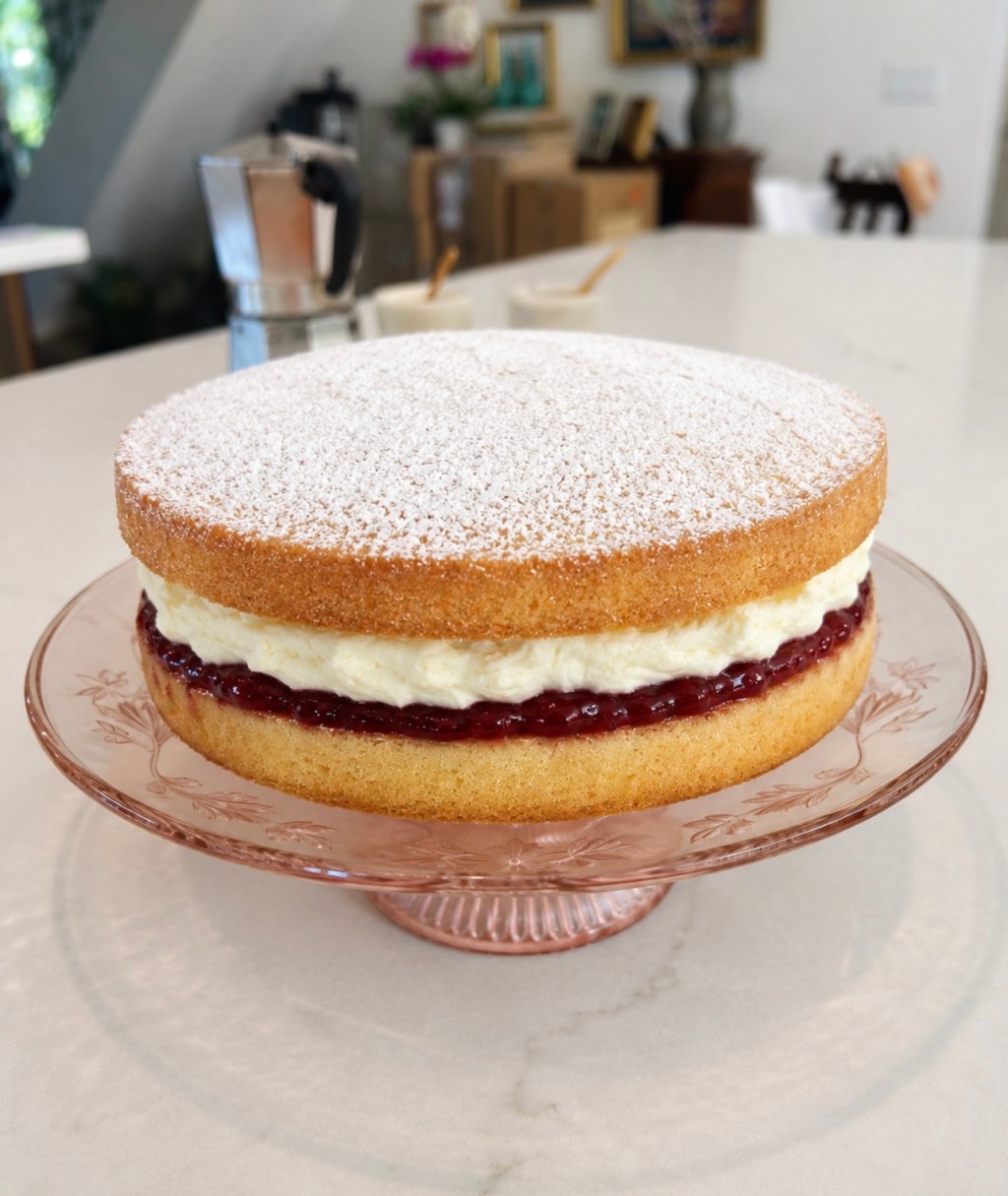
The recipe for this issue is a Victoria sponge, which is the most English cake imaginable and therefore the correct cake for an article about an Iranian teenager trying to be English in the late 1980s. It is light, it is elegant, it is named after a queen, and it could not be less rock and roll if it tried. I make it now and I think about Tottenham Court Road and the concerts and the magazines and the hair that my family has collectively agreed was a mistake.
Slash, for the record, would probably not make a Victoria sponge. At least this is one way in which I have surpassed him.
Classic Victoria Sponge
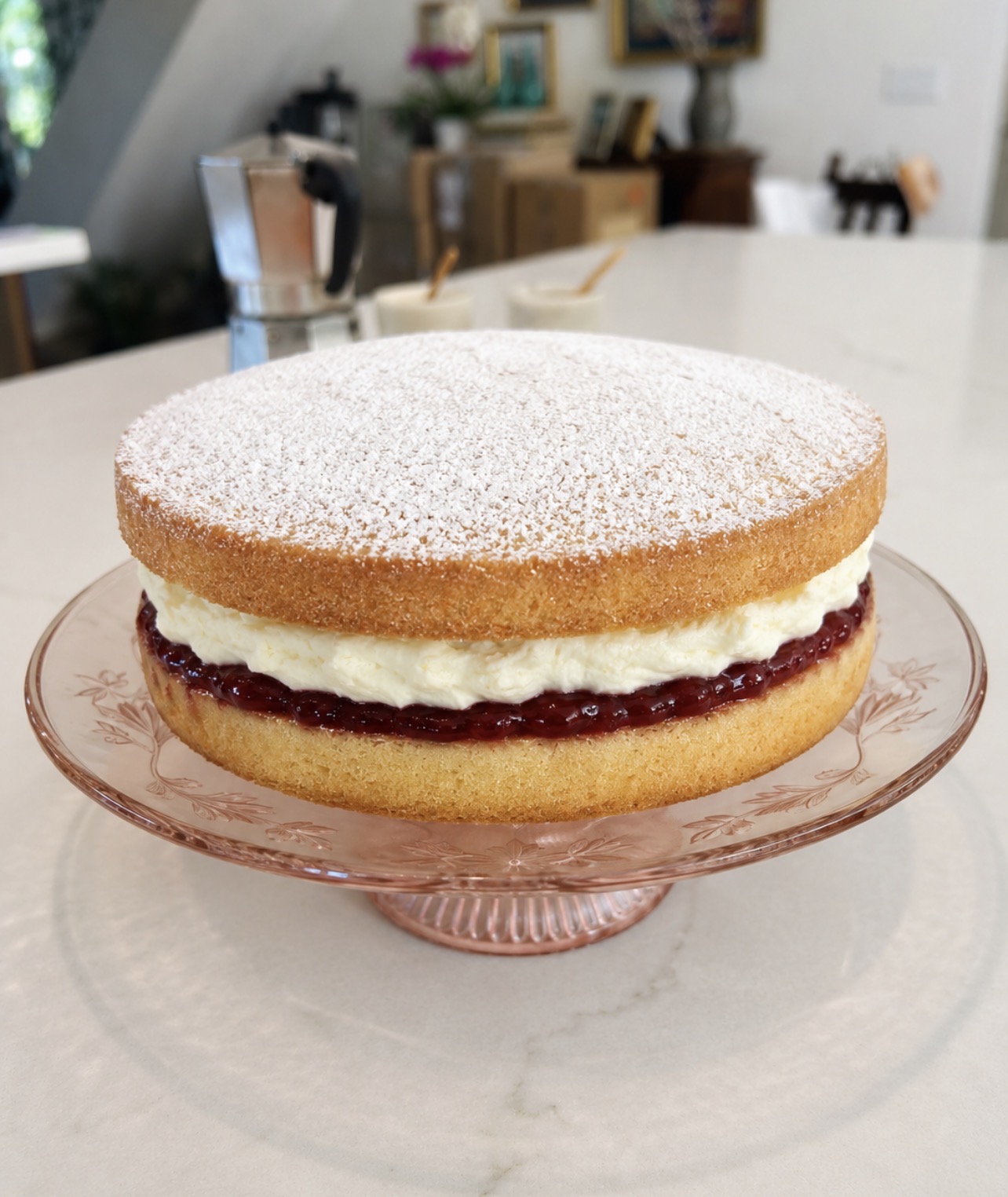
The Victoria sponge is one of those cakes that looks simple and is, in fact, simple, which does not mean it cannot go wrong. The two things that matter most are that your butter and eggs are genuinely at room temperature and that you do not overbake it. Everything else is straightforward.
Ingredients
- For the sponge:
- 225g unsalted butter, very soft
- 225g caster sugar
- 4 large eggs, at room temperature
- 225g self-raising flour, sifted
- 1 tsp baking powder
- 2 tbsp whole milk
- 1 tsp vanilla extract
- 200ml double cream
- 1 tbsp icing sugar
- 1 tsp vanilla extract
- 150g good strawberry jam
- Icing sugar, for dusting
For the filling:
To finish:
Directions
- Preheat your oven to 180°C or 350°F and grease and line two 20cm round cake tins. If you only have one tin, bake in two batches, it is worth it.
- Beat the soft butter and caster sugar together for a full four to five minutes until the mixture is pale, noticeably increased in volume, and looks almost fluffy. This step matters more than any other and cannot be rushed, because it is where the air goes in that makes the cake light rather than dense. Add the eggs one at a time, beating well after each one. If the mixture looks like it is curdling, add a spoonful of the flour and it will come back.
- Fold in the sifted flour and baking powder in two additions, working gently to keep the air you just spent five minutes incorporating. Add the milk and vanilla and fold until just combined. Divide the batter evenly between the two tins and smooth the tops.
- Bake for 20 to 25 minutes until the cakes are golden, have pulled away slightly from the sides, and a skewer comes out clean. Cool in the tins for five minutes then turn out onto a rack and leave until completely cold before you do anything else with them. Filling a warm sponge is how you end up with collapsed cream and a cake that looks like it had a difficult afternoon.
- For the filling, whip the double cream with the icing sugar and vanilla to soft peaks, stopping just before it looks done because it will firm up slightly as you work with it. Spread the jam generously over the bottom layer, going all the way to the edges. Spread or pipe the cream over the jam. Place the second layer on top, press down very gently, and dust the top with icing sugar.
That is it. There is no chocolate drip. There is no mirror glaze. There is no ganache or crémeux or anything that needs an overnight rest in the refrigerator. It is butter, sugar, eggs, flour, cream, and jam, assembled with care, and it is exactly as good as that sounds.
A note on the jam: use a good one. The jam is doing half the work here and a thin, oversweet supermarket version will undermine everything else. A proper strawberry preserve with actual fruit in it makes a noticeable difference. This is one of those places where the ingredient is the recipe.
P.S. If you had a teenage phase that your family has since reviewed and rejected, I would like to hear about it. Bonus points if there are photographs.


Leave a Reply